From the Back of a Horse
Some of the wildest hunts I’ve ever been on started when I climbed into the saddle
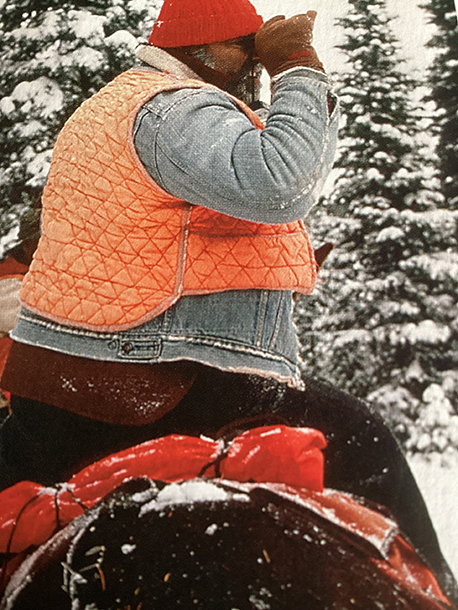
PHOTO: courtesy Jim Zumbo
by Jim Zumbo
I should have known better. The long, chaotic hunt that sent my companions and I churning through deep snow for hours was over, but my determination to ride all the way out to the horse trailer at the bottom of the mountain rose as my fatigue deepened. Then the trail turned to ice and my horse slipped.
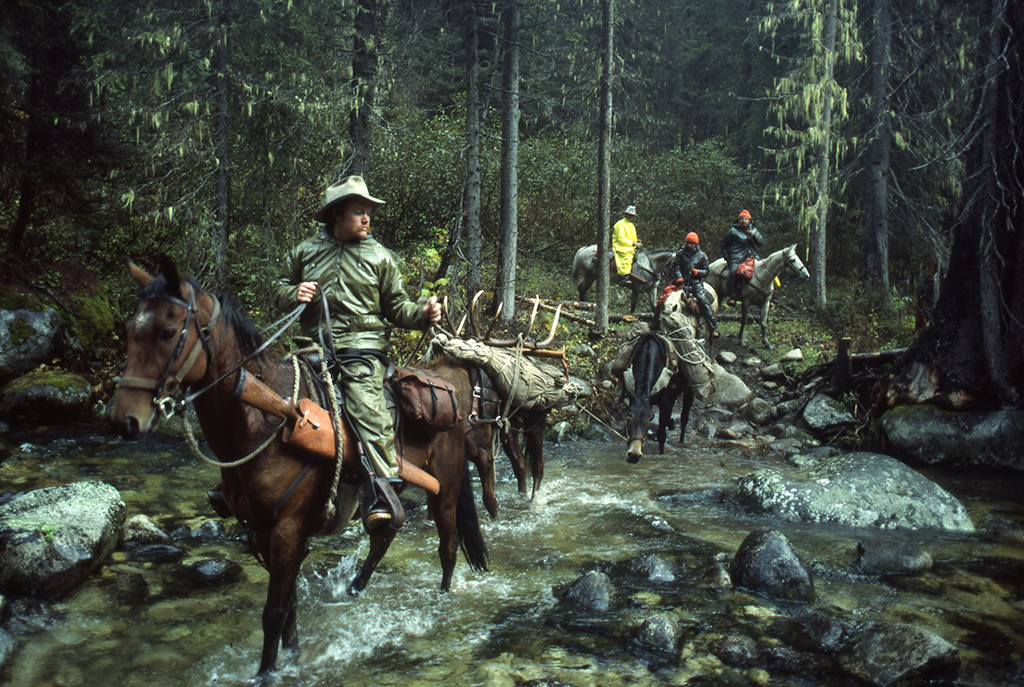
Sitting atop your favorite steed can be a joy as you drink in elk country that stretches from horizon to horizon. Horses take hunters and equipment to remote camps and pack elk meat to trailheads a dozen or more miles away. But with that extra ability to get far out into the wilderness comes brutal weather, tough terrain and long, cold hours in the saddle. Some of the wildest hunts I’ve ever been on started on the back of a horse.
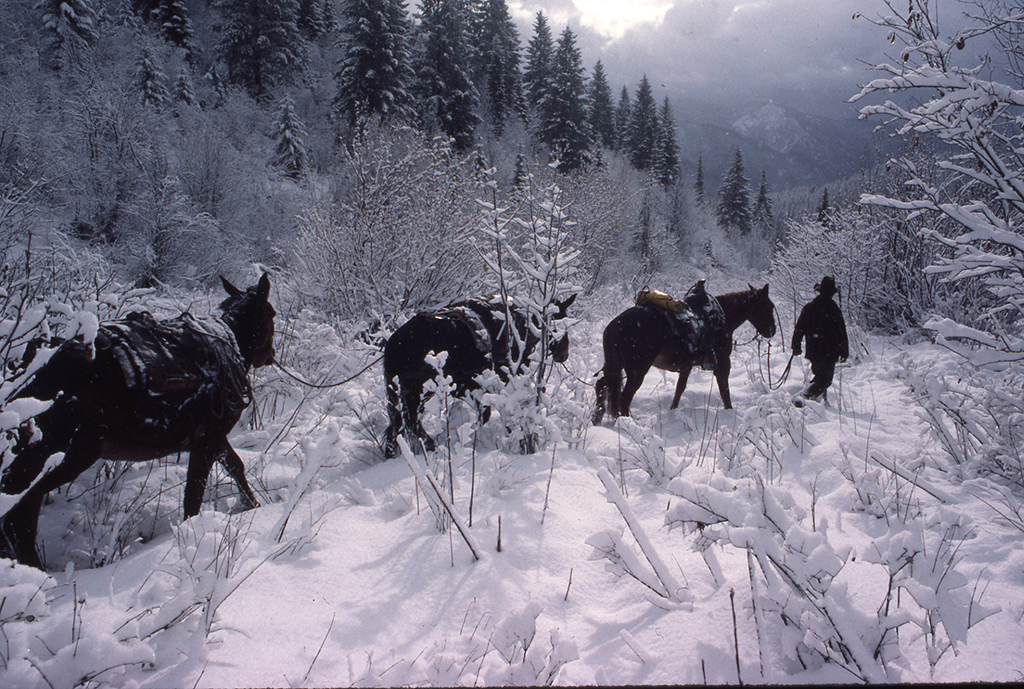
My companions for this particular icy hunt in 1988 were the legendary conservationist, stream access advocate and taxidermist Jack Atcheson Sr. of Butte, Montana, and Vin Sparano, an editor with Outdoor Life magazine. We’d scrambled into frozen saddles at 4 a.m. to hunt with outfitter Keith Rush in Montana’s Centennial Mountains. After riding rugged country most of the day, walking our horses frequently to keep warm in arctic weather, we spotted a herd of elk more than a half mile away. Keith decided he and his two guides would drive the elk to us. He directed my pals and I to find good overlooks on a ridge and watch the basin below. He sent his friend, Charlie, who wasn’t a guide, to tie our horses to an obvious tree in a clearing about a quarter mile away where we would all meet up at dark.
The plan didn’t work. Elk, being elk, had other ideas and fled a different way. When dark settled in, my pals and I descended a steep, snow-packed, treacherous slope and postholed to where the horses were supposed to be. Surprise, surprise. We found the appointed tree with horse tracks around, but no horses. Where in the world was Charlie?
Keith and the guides rode up. Typically a happy, if gruff, guy, he issued a string of invectives, dismounted and checked for tracks in the thick timber. Charlie had walked into the tight forest trying to lead four horses.
“Looks like he’s headed down the canyon,” Keith said. “The danged fool. He’ll never make it. The canyon narrows down in places where it’s barely two feet wide in the bottom. Worse, it’s got several waterfalls five to 10 feet high.”
While Keith and his guides rode into the dark timber to find Charlie, Jack, Vin and I, now afoot, decided to start walking toward the horse trailer a dozen miles away. We found what we thought was our trail and headed down, but the fluffy powder was so deep it was tough to tell what made the tracks. If you put your boot down and lifted it out, 18 inches of snow fell back in, leaving no evidence of an imprint—just disturbed snow. Moose, elk and deer left trails everywhere.
After an hour of wallowing through the deep snow and occasional drifts, Keith rode up. I’ll never know how he found us in the night.
“Where in hell you going?”
“To the horse trailer and a warm truck,” I answered.
“You guys are headed to Idyho.”
Jack fished out his compass, and I looked at the North Star. Keith was right. We were damned sure headed for "Idyho."
Keith and the guides still hadn’t found Charlie. Jack, Vin and I continued walking, in the right direction this time. A couple grueling hours later we spied the smoke and glow from a campfire down the mountain. We hurried to it like starving flies to a gutpile, falling frequently over unseen branches and snow-covered logs. Charlie, the horses, Keith and the guides hunkered around the fire. Keith had discovered Charlie bushwhacking through blowdowns, trying to fight his way to the bottom.
Vin walked up to his horse and kissed it squarely on the nose. We learned that Charlie thought he’d tied the horses in the wrong spot and elected to get out of Dodge. He was new to this area and had no idea what he was in for.
So, as I said at the beginning of this story, after leaving Charlie’s fire, I said “to hell with walking down the icy trail.” I wasn’t getting off my horse until I saw the pickups and trailers. I was on a good mountain horse that was accustomed to rugged terrain, and I trusted him. Bad decision. The horse started sliding and lost its footing. Knowing a wreck was possible, I had only the toes of my boots slid into the stirrups, so I ejected instantly. Gravity, ice and the horse combined to invite Murphy’s Law. My steed rolled over the top of my legs before I could evade him. The result was a sprained ankle. I’m amazed that’s all I got. Being rolled on by a half-ton animal is usually cause for alarm.
An hour later, an unseen branch poked Vin in the eye. It wasn’t serious but he was half blind for a while.
It was past midnight, 15 below, and whenever we crossed a small spring trickling across the trail, the water froze instantly into balls under the horses’ hooves. We had to dismount, raise each hoof and chip away at the ice with pocketknives, having only a small flashlight between our teeth to illuminate the bitterly cold project.
We made it to the trailhead, but our elk hunting was over on that trip, though I managed to hobble along a couple days later and sneak up on a five-point muley buck.
After the hunt, I took Vin to a favorite saloon in Wise River, Montana. Vin remarked several times that he couldn’t wait to order a Bombay Sapphire martini straight up, dirty and dry with two olives. I grinned but didn’t say anything. I knew the saloon and I doubted the bartender had ever served such a civilized drink. The door swung open to reveal half a dozen cowboys sipping beers. “What’ll you have?” the bartender asked as we sat on well-worn stools. Vin hesitated a moment, glanced around at the patrons and growled, “Gimmie a shot and a beer!”
I recall another wild horseback hunt, this time in the Canadian Rockies, when RMEF co-founder Bob Munson asked if I’d be willing to go on a hunt in Alberta with the winner of a sweepstakes. We’d hunt with outfitters Pat and Mike Bates in the same place where Clarence Brown had recently taken a monster typical bull. We all had met Clarence at RMEF functions. I agreed, of course, and learned that a man named Steve Ferguson won the contest (I wrote about this hunt about 30 years ago, but it’s worth retelling).
After arriving at the Calgary airport, I met Pat and Mike, and they introduced me to Steve. They were affable guys and said they couldn’t wait for the hunt. To be honest, I worried about Steve. He was a huge man, I mean really big. How could he tackle the rugged terrain? Did Pat and Mike have a horse big enough to carry him?
We continued to the luggage area and a man approached wearing a giant grin. There were video cameras pointed toward us. The man extended his hand. “Hi, Jim,” he said. “I’m Steve Ferguson.” At that, everyone broke into hearty laughter. I was set up. The giant of a man I’d been initially told was Steve, was actually a buddy of Pat’s who’d gone along with the ruse.
It was late November, and there were only six inches of snow, not enough to evict big bulls from Banff National Park a dozen miles west and onto the federal Crown land we intended to hunt for five days. Crown lands are like U.S. national forests, where no permission is required to hunt.
Several locals used a unique transportation system to haul gear, food and tack into camps. They employed horses to tow Conestoga-type wagons. Pat’s was red and white, and swayed impressively along the rocky roads. I was surprised at the number of camps in the area. Word had it that the sweepstakes ads in Bugle had attracted many locals. There were at least three dozen tent camps set up.
Our camp was unique in that there was an interesting outhouse behind the tent. A generator powered a heat lamp inside. The lamp had red cellophane over the light, casting an eerie pink glow. That was the first time I’d ever experienced a warm toilet seat in the backcountry. These Canadian guys knew how to improvise comfort!
We hunted hard for three days. Pat, Steve and I stopped riding only to look for fresh tracks. We glassed the snowy slopes. Sometimes we rode on trails, other times we bushwhacked across timbered country. The idea was to cover as much ground as possible far away from other hunters, riding at least 20 miles a day. Pat worried when he learned that not a single bull had been killed by any of the other hunters.
At one point we had to cross the Panther River. Beyond the icy edges was a torrent of open, fast-flowing water in the middle. A shelf of ice completely covered the river downstream. Our horses would have to walk across the shore ice, step or jump into the frigid water, wade across the river and jump back up onto the ice on the other side. If the horses slipped in the current, we’d be swept under the shelf of ice downstream. This was one of the times I was ready to say “nope” on an elk hunt, but I trusted Pat. My horse stumbled once but regained his footing. To say I was profoundly relieved when my horse reached the far shore would be a colossal understatement.
The next day was one of the toughest I can remember in the elk woods. Pat knew there was a lot of publicity surrounding this hunt. RMEF members would want to know the outcome. Going home empty is part of hunting, but this hunt had been advertised as the mother of all elk hunts given Clarence Brown’s exceptional typical and the reputation this area had for giving up big bulls.
“Here’s the deal, fellers,” Pat told us after dinner. “If you’re up for it we’re going to be in the saddle for 15 or 16 hours tomorrow and cover 35 to 40 miles. The weather forecast calls for hurricane winds up high. She’s gonna be bad nasty. If you don’t want to go, that’s alright with me. No elk is worth somebody getting hurt or killed.”
We had breakfast at 3:30 a.m. and sat in our frozen saddles by 4. As we rode out into the darkness I had to smile. This was high adventure. I almost looked forward to it.
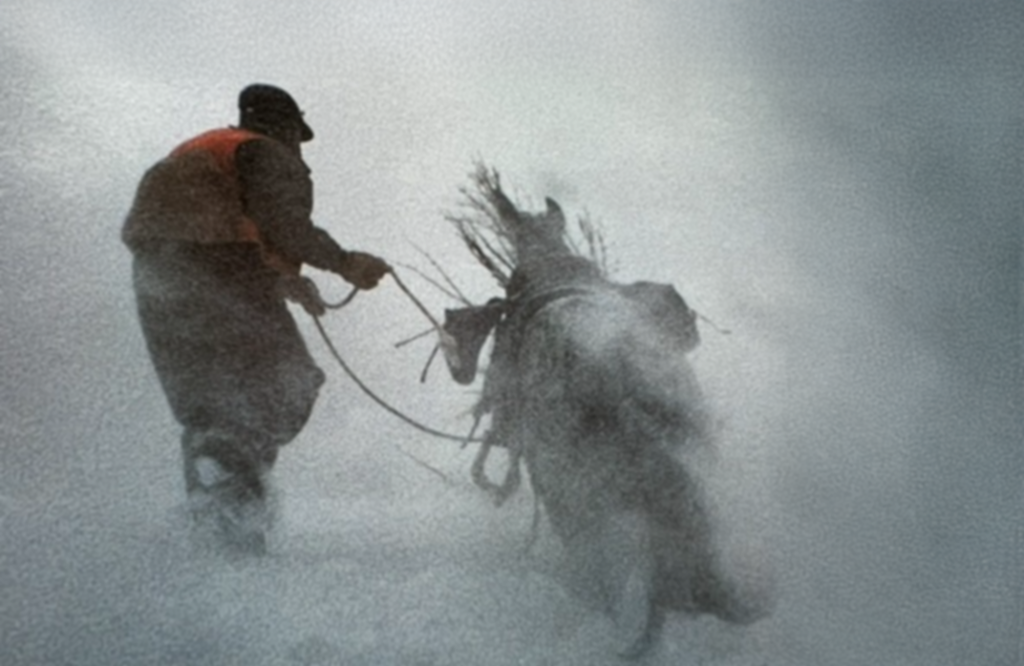
After several hours of riding in swirling winds, Pat was intent on riding to the rim of a basin that had produced for him in the past. The wind picked up as we rode higher and higher. On a game trail in the timber the wind calmed. As we rode out of the trees we approached a powder snowdrift towering four feet high. Pat led his horse through it first. The animal bucked and plowed through the drift, creating a cloud of churning snow that instantly reduced visibility to zero. The rest of us followed, and nature’s fury immediately punched the horses. Gale-force winds gusted so powerfully I could barely keep my eyes open or take a breath. All I could see was a frenzied scene of panicky horses and snow-covered humans. Pat was yelling, but we couldn’t hear him.
Most people would have abandoned ship and raced back into the shelter of timber, but Pat was on a mission. He was totally committed to that basin on the other side of the clearing.
“Hang on, fellers,” he yelled. “We only have a few hundred yards to go.” Riding was impossible. We jumped off our horses and walked beside them on the leeward side, clutching the reins and urging the reluctant animals along. The wind buffeted the horses about, making it hard to stay in a group.
I remember wondering, do we really want an elk this badly? Pat screamed something but I couldn’t hear what he was saying over the roar of the gale. He was three feet away. I moved closer. “Hold my horse’s reins,” he shouted. “I’m gonna run and peek over that rim.” He busted through the snow, flailing about, through the wind. He peered into the basin and shouted something. I believe those words were not fit for print.
We fought our way back to the shelter of the timber. We hunted hard the rest of the day and rode into camp around 10 p.m. It was Thanksgiving Day for Americans (Canadians celebrate their Thanksgiving in October), and the camp cooks had prepared a wonderful traditional turkey dinner with all the trimmings for us. We learned that wind gusts that day exceeded 100 miles per hour. I managed only a few bites before crawling into my sleeping bag.
After not enough sleep, we had breakfast. Through the grapevine Pat heard that someone had spotted elk tracks in a muskeg bottom close to camp. Was he serious? With all those camps around? “I don’t know what to tell you guys,” Pat said. “I’m out of ideas. Those bulls must still be hung up in the park, because no one has seen a big bull. Let’s try something stupid. We’ll ride and hunt most of the day and then come back to camp and sit by that muskeg bottom until dark.”
We saw nothing that day, and with two hours of daylight remaining, we sat in the snow and waited for the Golden Minutes when elk leave their daytime bedding areas and walk out to forage. We’d left our tent and walked past three other camps close to the muskeg bottom. No elk in its right mind would expose itself in the daylight hours, especially with people everywhere. Somewhere in the distance I heard the buzz of a chainsaw.
The sun finally disappeared over the western horizon, and I was ready to call it quits, just as Pat hissed, “Elk!” Then, “Bulls! Three of them!”
Impossible, I thought. Then I turned to see where Pat was looking. Three bulls walked out of the timber and into the opening. One was much larger than the others. Steve had first shot, after all, he’d won this hunt. I was just thrilled to be along. Moments later, two bulls were down. Steve’s was a beauty, scoring 363 inches. Mine was respectable and I could hardly believe the outcome. Pat Bates became my newest hero. That experience underscored one of my favorite sayings: “A hunt can turn from despair to ecstasy in a few seconds.”
Another horseback hunt to remember took place deep in Idaho’s remote Selway Wilderness in 1989. To get to outfitter Ken Smith’s camp you had to first fly in a small plane from Orofino to Moose Creek, landing on a dirt airstrip. During this white-knuckle flight, the pilot lined up with the runway and passengers prayed as they looked down at the wreckage of planes that didn’t make it. If you landed in one piece you tottered to Ken’s storage tent where horses waited, and off you went to Ken’s tent camp a dozen miles away through some of the most rugged country the Selway has to offer. His camp cook and helper, Elizabeth (who later became his wife), waited with a fabulous meal.
I named the four-mile ride from Ken’s camp to the hunting area the “Forest of Terror.” I hunted with Ken twice. We rode through the Forest of Terror twice a day for eight days during those two hunts. Most of the ride occurs in “slap-up dark” according to some Texas friends. To understand, walk into a closet with no lights. Raise your hand in front of your face. You can’t see it. You can see only total blackness. That’s slap-up dark. Now put yourself on a horse in slap-up dark on cloudy nights where there are no stars or moon. You can’t see the trees or the riders ahead of you. Sometimes you’ll see sparks flying when a horse’s shoe strikes a rock in the trail.
Luckily, horses have excellent night vision as most mammals do. It’s rare when a horse is night blind, bumping into trees along the trail. You don’t want to ride on that horse. Outfitters put their clients on trusted animals. The last thing an outfitter wants is to put a client in danger and see someone injured because of a knothead horse.
The Forest of Terror had three interesting obstacles. First was “The Log.” It was a log about 16 inches thick laying across the trail. A tall horse can step over it. My horse was tall, but he enjoyed jumping. The Log was a fun jump. When he lifted off, I’d be half asleep in the saddle and it was slap-up dark. Ken thought it was hilarious because his horse wasn’t a jumper. Then there was “The Branch.” This branch stuck out over the trail and was just high enough to knock my hat off my head. Somehow Ken knew when to duck and always avoided the branch. When my hat went flying, I had to dismount, turn my flashlight on and find it. Ken scolded me because shining a flashlight will mess with the horses’ night vision.
The last obstacle was “The Creek Crossing.” Because the creek was silent, I never heard it as we approached. My steed simply leapt off a two-foot bank, shaking me awake and eliciting more stifled laughs from Ken.
On one hunt, Ken and I spied a big bull across a canyon feeding on a very steep slope in an old burn. When I hit the bull, he started sliding. To my horror he free-fell off a 30-foot cliff and landed belly-down in a stand of saplings. After handshakes and hugs, Ken grinned. “You ready to work all night?” It would be dark in an hour.
We tied the horses, cut our way through thick underbrush and started in on the major project. The first obstacle came when freeing the bull—he was stuck in saplings as tight as a cork in a wine bottle. We sawed more than a dozen trees out of the way and rolled the bull just enough so we could field dress him. That confined space caused slow going, especially since we couldn’t move him around much. A few hours later we’d skinned and quartered him, leaving the meat hanging high in trees and arriving back in camp around 2 a.m. We returned the next morning with two packhorses, and with Elizabeth’s help, made a better trail through the dense brush. Without horses, it might have been best to heed the tongue-in-cheek advice from veteran elk hunters: “Bring a skillet and eat him where he lays.”
These are some of my fondest horseback hunting memories, all with outfitters. I’ve done countless hunts with my own horses that also provided many laughs, like the time I hunted with my buddy Dr. Parker Davies, a retired physician from Montana. He and I and two other pals rode to a camp in a national forest, expecting pleasant weather due to a positive forecast. Nonetheless, Parker and I brought in a small tent and set it up, just in case. The other guys heckled us for being sissies. They would sleep beneath the towering spruce and stars. About midnight, after visiting around a campfire we heard thunder in the distance. “That storm will never reach us,” one of the macho guys quipped. A half hour later a torrent of rain slashed down. Parker and I scrambled into our tent while the tough guys covered themselves with sweaty horse blankets.
Then there was the time my buddy Ed Iman, a fishing guide on the Columbia, came up with a plan for him and me and his buddy Pete to hunt elk in eastern Oregon’s Hells Canyon along the Snake River. Ed’s first mistake was renting three horses. Since we had horses, we needed to camp close to a waterhole. In search of a camp we’d been advised to use, we struck off in the wrong direction, finally giving up and making camp in the single flat spot in that country where a trickle of water bubbled out of a spring. I don’t believe there are a half-dozen places there where it’s flat enough to sit and play a decent game of poker.
Before finding that camp the horses decided to separate when attempting to walk through some trees, but they were tied together in a string. A rodeo erupted when the horses panicked, scattering gear down the mountain. Ed’s gun took a hard hit when it was ejected from the scabbard. It didn’t matter anyway because we never saw an elk during the entire hunt. That, in fact, is how many elk hunts, even with horses that can take you places you might not otherwise reach, wind up. But I always forget the tag soup and go back for more. Elk—and horses—have a way of doing that to you.
Jim Zumbo is an RMEF Life Member and early supporter of the organization. He is a prolific outdoor writer and a former hunting editor of Outdoor Life, authoring multiple books on hunting and producing outdoor television shows. He was recently inducted into the Wyoming Outdoor Hall of Fame and is a recipient of the Wallace Pate Award, which is RMEF’s highest honor.